
The Salt Was the Strategy

On 26 January 1930, India publicly declared itself independent.
Lakhs gathered. The tricolour went up across the country. The pledge was read out and affirmed by a show of hands. It was a genuine national moment, and it changed nothing about British rule. The next morning the trains ran, the offices opened, and Indians bought salt at the price the empire set.
Six weeks later, a sixty-year-old man walked out of Sabarmati Ashram with seventy-eight volunteers and started walking towards the sea.
Twenty-four days. Roughly 390 kilometres. On the morning of 6 April, at Dandi, he picked up a lump of natural salt and broke the law. By the end of that year, around 60,000 Indians were in prison for civil disobedience.
The goal did not change between January and April. Not one word of it. What changed was that people had an experience.
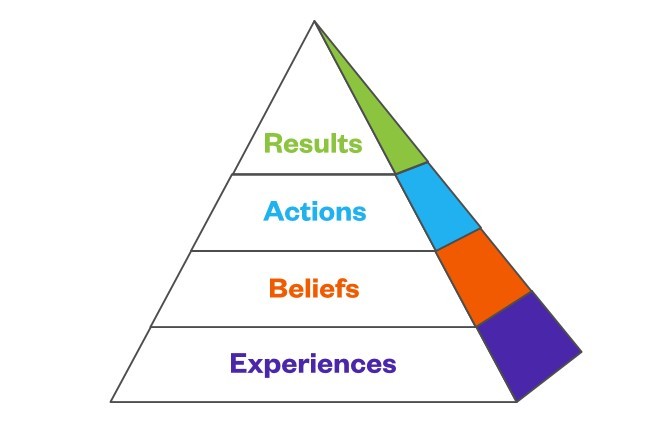
The pyramid was upside down in January. The Results Pyramid® holds that results come from actions, actions from beliefs, and beliefs from experiences. The declaration was aimed at the top two layers. The march was aimed at the bottom one. Only the second moved a country.
Every strategy deck circulated without a corresponding experience repeats the January mistake. Generations of colonial rule had produced something more durable than force, a settled sense that this was simply how things were. Below the Line® at national scale. Gandhi did not argue people above the line. He walked them there.
He chose salt on purpose. It was in every home, and the tax fell hardest on the poorest. Seeing it was easy: the sea is right there, and you may not touch it. Owning it cost something real. Solving it needed nothing but your hands. Doing it took four seconds. See It®, Own It®, Solve It®, Do It®, compressed into a gesture a country could copy by Monday.
And it did copy. Rajagopalachari marched in Tamil Nadu, Kelappan in Malabar, Dasgupta in Bengal. Nobody waited for a central rollout plan.
Ask what the most junior person in your building does differently because of your transformation. If the answer takes more than one sentence, you don’t have a culture. You have an announcement.
He declared it, then went first. Gandhi wrote to the Viceroy in advance, stating exactly what he intended to do, then did it himself, at sixty, in front of the world’s press. Accountability that starts below the leader is compliance. Accountability that starts with the leader becomes culture.
Then it took seventeen more years. 1930 was when belief changed. 1947 was when the result arrived. Companies that abandon a change programme after two flat quarters usually quit at the exact moment the beliefs finally start to move.

One capability underneath all four: converting intent into ownership. Across levels, over time, under pressure.
It has never been easier to avoid. The newest Below the Line® alibi is beautifully modern: the model generated it or the Generation gap is too wide.
That capability is what India’s Top 100 Accountable Leaders™ in the Age of AI is built to find and develop. A six-month journey through the Results Pyramid® and the wider Culture Partners frameworks, built on research conducted in partnership with Stanford University. One hundred leaders named on 10 September.
Independence was not won by people waiting to be told.
Nominations close 31 August → https://top100accountabilityleaders.doortrainingsea.com/
This article was first published in Unlocked, DOOR International SEA’s weekly LinkedIn newsletter. Read it on LinkedIn →
Work with DOOR
Want to put these ideas to work?
Talk to our team about how DISEA can help your organisation build accountable cultures and adaptive leaders.
Book a Discovery Call →