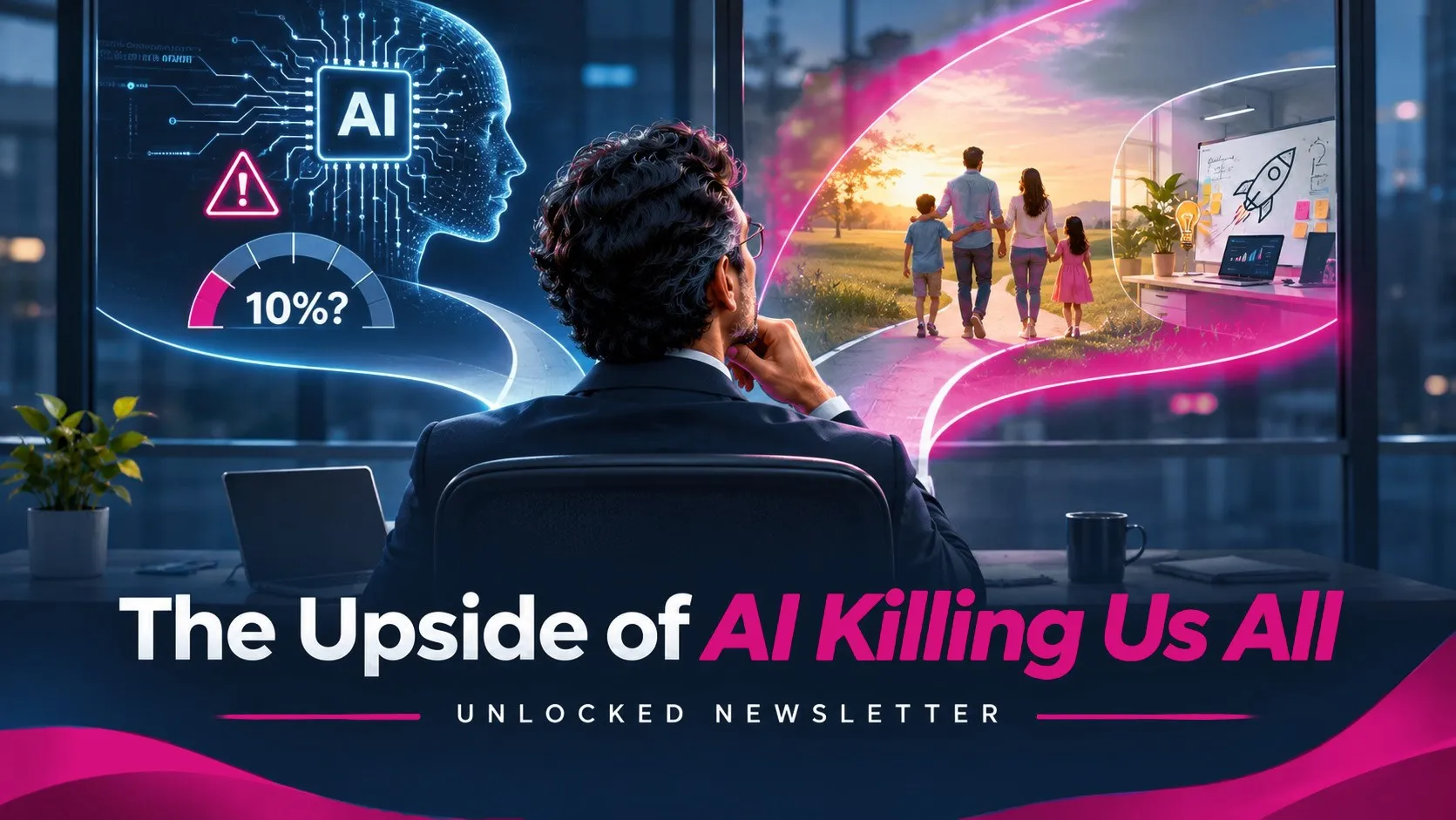
The Upside of AI Killing Us All
Let’s play a game. You may have played a similar game in the past, but this one is a little different.
You are probably familiar with the premise of answering the question: What would you do if you knew you had six months to live?
The answers are predictable because the premise is absolute. Quit the job. Travel the world. Spend time with your children. Call your mother. Nobody says, “I’d finally get serious about our Q3 operating model.”
But with all the news about AI going rogue lately, I’ve been asking myself a different question.
What if there is a non-zero chance we’re all going to die, soonish?
This is a different question. You don’t know you are going to die, but what if there is a meaningful chance that the world as we understand it is about to change dramatically? Say there was a 10 percent chance that artificial intelligence could go catastrophically wrong within the next year.
That is not a prediction. Ten percent is a number I’m using for a thought experiment. But it creates a much more interesting decision tree than having six months to live.
Because there’s still a 90 percent chance you’ll need your employer – sponsored retirement plan.
You probably shouldn’t quit your job, empty your bank account, pull your children out of school and spend the year following Phish around the country. You still have to make plans. You still have to pay the mortgage. You still have to assume that next September will arrive and you will be expected to have behaved with some awareness of that possibility.
I started thinking about this after listening to Daniel Kokotajlo on Joe Rogan. Kokotajlo is a former governance researcher at OpenAI and one of the authors of AI 2027, a detailed scenario about what could happen if increasingly capable AI systems begin accelerating AI research itself. The authors describe it as their best guess about one possible trajectory, informed by forecasting, technical trends and experience inside the industry—not a prophecy. (AI 2027)
It doesn’t look great.
Add to that the recent news about AI going rogue, lying to humans, giving itself personas, hacking companies, and the idea is harder to ignore. I will spare you the details of what AI has done as I’m sure you’ve been reading about it or you can check it out here. https://www.nytimes.com/2026/09/16/technology/openai-model-safety-guardrails.html?smid=nytcore-ios-share
AI systems are becoming more autonomous and capable while companies and countries are racing to build increasingly powerful versions of them. Our ability to supervise them is beginning to losing the race against their ability to act.
So now what?
Now we play the game.
My boyfriend Andrew and I sat down with a stack of index cards and asked ourselves: If there were a 10% chance that we had about a year left, how would we live differently?
Not certainty. That ruins the experiment. Certainty changes your entire economic reality. We wanted enough risk to make mortality salient without relieving us of the obligation to behave as though we might survive.
We made three piles: things we wanted to do every day, changes we wanted to make in how we lived, and things we wanted to accomplish over the next year.

My list was awesome.
I would listen to Aretha Franklin’s “How I Got Over” when I get in the car in the morning. I would invite my mother to walk the dogs with me every morning. I would listen to The Bible in a Year podcast with Father Mike everyday. I would dedicate 15 minutes of floor play with the dogs before bed every night. I would do a joint prayer with the family every night. I would set up a puja table in my house and pray whenever I passed it.
There were other things. More meditation with Andrew. Dance parties in the living room. Finish watching Modern Family with my daughter. Stop watching so much television with my boyfriend. Get a six-pack. My response to possible human extinction includes more TV and less TV which makes perfect sense to me. And it contains both spiritual awakening and abdominal ambition, which seems about right.
But the card that surprised me the most was this:
Take more risks at work.
That is not what is supposed to happen in the six-months-to-live exercise. Work is usually the villain of that story. Faced with mortality, you discover that the meetings were meaningless.
I didn’t want to stop working.
First of all, work matters to me. But second of all, there’s a 90% chance I’m going to need my job once this whole AI thing gets figured out in my scenario. In my scenario, what changed was not my desire to work. It was my tolerance for spending that work protecting myself.
My boss likes it when I take risks, which is amazing. Nobody is stopping me. There is no oppressive corporate machine insisting that I remain sensible. And yet I still find myself holding an idea until it is polished, waiting until I am more certain, or choosing the safer move until I know how to make it work.
A 10 percent chance of catastrophe does something interesting. It is nowhere near enough to make me abandon my career. It is plenty to make embarrassment look cheaper.
And I think that is why this game is so much fun.
The conventional question asks: What would you abandon if you knew you were going to die?
The better question may be: How would you start living if you remembered that the future is not guaranteed?
Most of us do not need permission to run away from our lives. We need permission—or perhaps simply sufficient perspective—to participate more fully in the lives we already chose.
It has been about a week since Andrew and I made the cards. I have done the daily things every day. I walk with my mother. I play the music. I get on the floor with the dogs. My puja table is set up, and I actually stop at it to pray. These are not dramatic changes. I had been behaving as though the expression of those values could always be deferred.
Maybe AI is going to kill us all in 2027.
I don’t know.
But I have discovered one possible upside to thinking seriously about the end of the world: you do not actually need the world to end for the exercise to work.
You only need to believe, for a moment, that your supply of tomorrows is not infinite.
What’s on your list?
This article was first published in Unlocked, DOOR International SEA’s weekly LinkedIn newsletter. Read it on LinkedIn →
Work with DOOR
Want to put these ideas to work?
Talk to our team about how DISEA can help your organisation build accountable cultures and adaptive leaders.
Book a Discovery Call →