
Every working morning, around 5,000 men in white cotton caps move more than a lakh home-cooked lunches across Mumbai. No app, no GPS, no barcodes, just painted codes on tin boxes, local trains, and bicycles. Their accuracy is famously estimated at one error in six million deliveries. Harvard flew down to study them. Most companies with a thousand times their budget can’t match them.
Now consider what Mumbai offers them every single day: a full menu of Below The Line® behaviour. The monsoon arrives, wait and see. The train is delayed; finger-pointing has never had a better alibi. The box changed three pairs of hands, not my job. A delivery goes wrong, ignore or deny, who would ever trace it? No supervisor is watching, so cover your tail, or simply wait for someone to tell you what to do. Every one of those six exits is open, every day, and every one of them is justified. That is the trap of Below The Line: it doesn’t feel like failure. It feels like a reasonable explanation. And nothing changes there.

The dabbawallas take the staircase instead. See It®: the colour-coded system makes every gap instantly visible; a box in the wrong place cannot hide, and neither can the problem. Own It®: each dabbawala owns his boxes end to end, not his leg of the relay, but the lunch itself. Solve It®: a missed train doesn’t trigger a meeting; it triggers a reroute, on the spot, with whatever the moment offers. Do It®: and so, by lunchtime, through floods and festivals and 130 years of Mumbai, the dabba arrives. Four steps, climbed daily since 1890, without a single workshop on accountability.
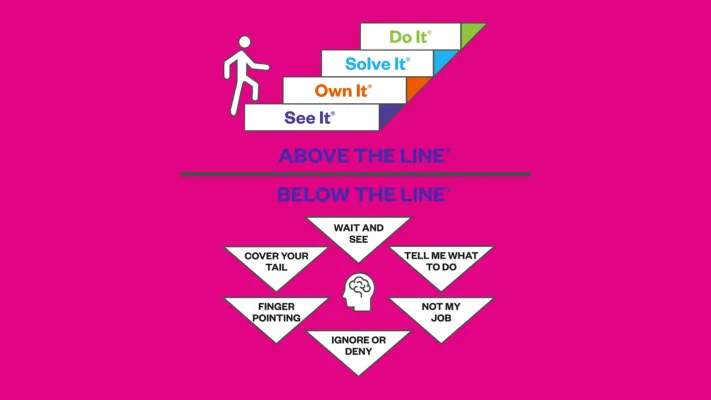
Here is the uncomfortable mirror: most organisations have more data, more dashboards, and more degrees than the dabbawallas will ever hold and longer explanations for why the result didn’t arrive. The difference was never resources. It is the side of the line a leader chooses when the excuse is genuinely available. That choice, repeated daily, is what a culture is actually made of.
Leaders who make that climb instinctively are exactly who India’s Top 100 Accountable Leaders™ in the Age of AI is built to find and develop, over a six-month journey on these very frameworks: Stanford-validated, drawn from 7 published books, trusted by 1,700+ organisations worldwide.
Take the first step. Nominate yourself before August 15 → Join